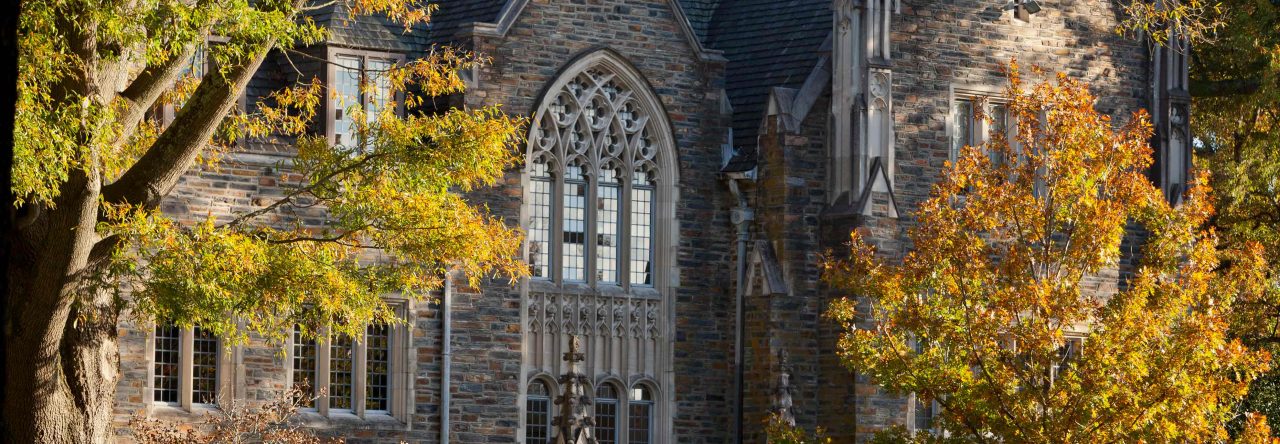
Arches filled with windows and the stone front of the Allen building late in the day with fall colors in the trees

Category: Uncategorized

Annual Address to the Faculty: Duke is Made for This

Thank you, Mark. Let me begin by thanking you for your leadership. And I’m grateful to all of the members of this Council for your service. Your ongoing work sustains the strong traditions of shared governance at Duke, built over generations by many, including George Christie, whose passing we’ve mourned this year.

At this time last year, I spoke with you about the many challenges we face: dwindling public support of higher education and academic research; a precipitous decline in our primary sources of external funding; rapid introduction of new technologies, particularly artificial intelligence, that disrupt established practice; and a social, political, and cultural milieu characterized by instability and heightened conflict.

I talked then of our need to be prepared, not only to seek cost-reductions across the university, but also to re-imagine our work and consider how we might strategically realign around our highest priorities.  

In the time since, we have continued to face challenges, and we’ll discuss some of those in our upcoming executive session. But even as colleagues across the university continue adjusting to new ways of operating, I believe we have made important strides.

Indeed, as the name of our current fundraising and alumni engagement campaign signals, Duke is Made for This.  Made for this moment of change and uncertainty. Made for a world that will need, now more than ever, a liberal arts institution with our particular culture, sensibilities and expertise.  

My confidence is reinforced by the many different people I encounter every week, both here on campus and in my travels.  

I consistently hear from them that Duke is recognized for our remarkable forward momentum, and for making value-driven decisions that are positioning us for a brighter future.

My confidence is also grounded in the tangible progress we continue to make toward the five overarching priorities I articulated to this Council in my first annual address in 2018: Empowering our people; transforming teaching and learning; strengthening community; partnering with purpose in Durham and the region; and engaging our global network of alumni and friends.

Let me take each area in turn.

First, we are empowering our people. Times like these remind us that Duke is an extraordinary university because of the students, faculty and staff who bring our missions to life. And even though circumstances have forced us to become smaller, we undertook our strategic realignment precisely to ensure we could continue to invest in our people.

Our students are the embodiment of our future. Notwithstanding constrained financial resources, we’re expanding our commitment to making a Duke education accessible and affordable. Our annual expenditures on undergraduate student financial aid exceeded a record $200 million this year. I’m especially proud that our initiative for students from the Carolinas and additional strategic measures have resulted in quite substantial increases in socio-economic diversity among our student body. And beyond financial aid, we’re prioritizing support for first-generation students and those from lower-income backgrounds, to ensure that they can take full advantage of all Duke offers. 

We’re also investing in you, the faculty who propel our teaching and research missions and inspire us with pathbreaking scholarship—impactful work like that I witnessed recently in the lab of Professor Nanthia Suthana. There I met a military veteran who suffers from severe and formerly untreatable PTSD. Now he’s finding life-changing relief from a novel, tiny implant capable of monitoring his brain activity, predicting when PTSD symptoms will occur, and proactively delivering interventions to short-circuit those debilitating symptoms. 

Empowering this type of work requires continuous investment in faculty excellence, and our ongoing campaign has already raised over $300 million for endowed chairs, with a goal of raising $2.5 billion for faculty support, including chairs, discretionary funds, and research support.  

Another way we’re investing in faculty is by supporting research translation and commercialization, moving discoveries from the lab into the market. Since 2020, this work has led to more than 1,600 invention disclosures and generated nearly $500 million in licensing revenue—revenue distributed back to you, and your labs, departments, and schools to support further research and innovation.  

And the world is taking note of your extraordinary achievements. Duke has been recognized among the top six institutions in the world in each of the first two years that the Times Higher Ed has published its Interdisciplinary Science Rankings. Over the past five years, 32 Duke faculty members have been elected to the American Academy of Arts and Sciences, and the National Academies of Sciences, Engineering, and Medicine. These new members represent fully 21 percent of Duke’s living members of those distinguished honorary societies.

Our clinical faculty, too, are a critical part of Duke’s mission. Duke University Health System is returning to a position of financial strength, thanks to our integrated physician practice, which has unlocked capacity for growth and expansion of our world-renowned academic medical center. Forward-looking projects—like a proton therapy center for advanced cancer care and our partnership with UNC to build the state’s first stand-alone children’s hospital—will ensure that patients here in Durham and throughout North Carolina will have even greater access to world-class care. 

We’re also making tangible progress on the second part of our strategic vision, transforming teaching and learning. 

Our progress includes several recent, faculty-driven curriculum enhancements: the new Trinity College curriculum; the Pratt School’s first-year design curriculum and Character-Forward initiative; the School of Medicine’s new Patient-FIRST curriculum; and our new Center for Community-Engaged Scholarship. All of these ground our teaching in experiential learning opportunities and in professional decision-making contexts.  

Duke continues to be distinguished by our interdisciplinary and experiential education programs such as Bass Connections and DukeEngage. The Data+ program has supported 140 projects over the past five years, ranging from advanced mathematical sciences to art restoration, with nearly a third of its projects in the computational humanities. And we’re poised to implement recommendations of the 2030 Teaching Excellence & Innovation Committee, which will improve the ways we define, evaluate and support effective teaching and mentoring practices.  

And as we confront both the opportunities and potential downsides of artificial intelligence, we’re building on more than a century of excellence in liberal arts education, committed to asking the most fundamental questions, such as:

  • How can we ensure that a generation of students who have always had instant access to information will also experience the power of deep scholarly immersion and reflection?
  • How can we responsibly deploy AI and other tools to augment and deepen, not erode, our human capacities for rigorous inquiry and creative exploration?
  • How can we preserve the thrill of intellectual discovery in a digital age? 

As I recently shared with colleagues at the Franklin Humanities Institute, these are some of the questions we, as faculty colleagues, need to wrestle with as we look to the future of teaching and learning. 

I’m also heartened by the progress we’ve made toward the third element of our strategic vision, which is nurturing a campus community where everyone feels supported in reaching their fullest potential.

We have now fully implemented the QuadEx undergraduate living and learning model, and it is succeeding in enhancing faculty engagement with undergraduates and fostering belonging and well-being from our students’ earliest days on campus.

As we strive to be a community of people who embrace our differences and learn from our disagreements, we’re providing structured opportunities for developing and practicing habits of constructive engagement. We’re investing in new programs to help faculty advance constructive dialogue and integrate core values of pluralism, free inquiry, and belonging in the classroom. 

Five years ago, we introduced a campus-wide culture survey that marked the first time all internal constituents—faculty, students and staff—were asked to share their experiences and perspectives on life at Duke, and it has motivated us to seek new pathways for staff career advancement. Data from our second campus culture survey, administered in 2024, indicate we’re making positive progress in the lived experience at Duke. But there is more to be done. This January marked the fourth year that began with more than 300 university leaders coming together for a day-long meeting focused on achieving inclusive excellence as a university, and at the department and unit levels.

The arts are also a vital aspect of building community, and with the leadership of Vice Provost Deborah Rutter, former Director of the Kennedy Center in Washington, DC, we’re extremely well positioned to expand the role of the arts on campus, in the Durham community and beyond. We’ve implemented recommendations of the 2019 Arts Planning Group and invested in key campus assets such as the Nasher Museum; the Sarah P. Duke Gardens; and our newly restructured Center for Documentary Studies. 

Duke Athletics is another fundamental contributor to community.  As the landscape of intercollegiate athletics continues to change at a bewildering pace, we are committed to ensuring that Duke provides a world-class student-athlete experience and that athletics continues to serve as a positive influence on the university’s national and global reputation.

Our investments in excellence are yielding clear results in this domain as well. We are now the first school in ACC history to win conference championships in football, and men’s and women’s basketball, all in the same year. And we should all be proud that Duke holds one of the nation’s leading Graduation Success Rates, and that our student-athletes have led the Atlantic Coast Conference in ACC Honor Roll selections for 36 of the past 37 years. 

The fourth element of our strategic vision is partnering with purpose to advance health and well-being in Durham and the region.

As our hometown and region experience tremendous growth, we’re taking new steps that are in direct alignment with our core missions and that seek to ensure that all residents benefit from regional advancement.

One is the Durham Early College of Health Sciences, which welcomed its first class of ninth graders last August. This pioneering high school is a collaboration among Duke, Durham Technical Community College, and Durham Public Schools, with funding from Bloomberg Philanthropies. The school provides pathways directly to healthcare careers at Duke while also building our region’s healthcare workforce.

We are living up to our Climate Commitment. We’ve now expanded our goals for reducing our operational impact to include not only carbon, but also waste, water, transportation, and food, and our Health System is being incorporated in climate and sustainability goal planning for the first time.

And this week, we’ve formally launched HomeGrown, a transformative initiative that represents a $200 million commitment to our community over the next three years.

Through HomeGrown, we’re aligning Duke’s core business operations with the economic health of our region, with measurable goals across several priority impact areas:

  • Through employment at Duke;
  • Through purchasing from local businesses;
  • Through our construction projects;
  • And through investment, by partnering to increase housing supply and by expanding homeownership pathways.

We are making specific commitments in each of these areas, with public reporting and with measurable goals.

The fifth element of our vision for the future is activating our global network of alumni and friends, through programs to support their lifelong growth and by engaging them as partners in advancing our educational, research, and service missions.

Our campaign, Made for This, is the first in Duke’s history to have explicit objectives for both fundraising and alumni engagement. 

Last month, I spent time with some of the 500 alumni and friends who visited campus as part of Women’s Weekend. This summer dozens of alumni will return to Duke for the third installment of the Forever Learning Summer Academy. There, they will indulge their love of learning in week-long courses on topics including Boccaccio’s “Decameron,” and Lincoln and the Civil War.

Last year alone, over 25,000 Duke alumni attended events and programs like these around the world, and more than 14,000 volunteered their time to support our students or their local communities. Over 33,000 alumni made a gift or pledge last year to support our work as a university. This is why our campaign has been so incredibly successful from a philanthropic perspective. Just one year into its public phase, it has already become, by a wide margin, the most successful fundraising effort in Duke’s history.

Empowering people; transforming teaching and learning; strengthening community; partnering with purpose; and engaging our global network. Owing to extraordinary efforts across all five of these priorities, we are today well positioned to lead even—perhaps especially—in tumultuous times.

Indeed, this moment of profound ferment offers, at least to an enterprising and ambitious institution like Duke, an opportunity to ascend in the next century even more so than in our remarkable first 100 years. 

I’m grateful to have had this opportunity to serve as president as we crossed our centennial threshold; and guided by our strategic vision, I look forward to working with you to secure our trajectory for an even brighter future.

Thank you.

Thanksgiving Greetings

As we approach the Thanksgiving holiday, I want to take a moment to express my heartfelt gratitude to you—our students, faculty, and staff. 

Together, you make Duke an extraordinary community.

We all know that this has been a challenging year. We’ve faced difficult choices and changes as we’ve navigated a shifting landscape in higher education. Yet even in times of uncertainty, I continue to be inspired by the 
creativity, compassion, and resilience that define Duke.

Across our classrooms, hospitals, clinics, and labs—and in communities near and far—you have shown what it means to live our mission with purpose. And you have shown up to support one another, in moments of challenge, 
and in moments of celebration.

While many of us will take time this week to rest and reconnect with loved ones, I want to extend my special thanks to those who will be working through the holiday: caring for patients, maintaining our facilities, and supporting essential operations.  

Your dedication sustains us all.

I hope during this Thanksgiving week, you can take some time to reflect, recharge, and feel pride in the difference you make here at Duke.

Thank you, and best wishes for a peaceful and restorative holiday.

2025 Opening Convocation Address

Good afternoon to the great Class of 2029! On behalf of the administration, faculty, and staff, I’m delighted to welcome you to Duke University.

It’s been just over a week since we gathered right here in Cameron for the Family Farewell. 

I hope you’ve now begun to settle in on East Campus, including getting to know the wonderful staff of the Marketplace over in the Wall Center. 

I also hope that you’ve made some new friends; explored interesting topics and activities during Experiential Orientation; and are now excited to formally begin your academic careers at Duke.  

We’re certainly excited for you. A lot of people—staff, faculty, and your fellow students—have been hard at work helping you get oriented.  

But I’m guessing that, notwithstanding their best efforts, and your best efforts at ExO, you may still be feeling a little disoriented.

That’s completely understandable. This is still a new place, with new people, and new routines.  

Nothing is quite where it used to be in your life. It’s a lot easier to get lost, and to lose things. 

You have this strange new person sharing your room. Strange in the “don’t-really-know-them-yet” way, I hope, rather than in the “just-plain-strange” way.   

Making things even more disorienting, you’re getting to know two campuses, east and west, and the bus lines connecting them. 

And to double down on the disorientation, we’ve turned a fair amount of both campuses into construction zones, just for you.

I’m guessing you are probably hoping to be thoroughly oriented as quickly as possible, maybe craving that sense of deep familiarity with your surroundings, that confidence in knowing your way around all these people and places and routines like they were second-nature. 

But my message to you today is that you should instead treasure this profound disorientation.  

And you should try very hard to hold onto it.

I say this for three reasons.

First, unfamiliarity makes us unusually alert to our surroundings. When you don’t know what you’re looking at, your mind works a little harder, your eye detects things that might otherwise escape notice. In your struggles to make things out, you really see.  

On the other hand, once you understand what you’re looking at, you don’t have to look at it very hard, because you recognize it. And thereafter, you see what you recognize—not necessarily all that is actually there to be seen. 

This process is natural. It’s efficient. It helps us minimize the work that goes into our daily lives. But it comes at a cost. In a very real way, it dulls the senses.

When you’re disoriented—feeling like a stranger in a strange land—life can be uncomfortable and confusing at times. But that state of being confused also gives you a kind of observational super-power.  

And if you can relax enough to embrace your confusion, if you can translate it into curiosity—then your mind is ready to learn. You are ready to grow. 

Scientists refer to this as neuroplasticity, the ability of our brains to build novel connections—to re-wire ourselves, as it were. Neuroplasticity is at its peak in early childhood, in part because of physical brain development, but also because in childhood our lack of experience forces us to make sense of a whirl of completely novel situations. Everything is new. The rules of sensemaking are not yet developed.  

As every parent has experienced, life with a child is an unending conversation about whyAnd unbridled, childlike human curiosity, while at times truly exhausting for everybody involved, is one of the great wonders of life.

Well, in your disoriented state as a new Duke student, you have an opportunity to reclaim that unbridled curiosity, but now with a much keener intellect and a larger, if not yet fully expansive, fund of personal experience.  

This new place, these new friends, these new courses and projects, and new explorations in art and science alike: they are ready for your sensemaking, and, I hope, another series of conversations, profound conversations, about why.  

In your disoriented state, you should take a break from making personal statements—you already gave us those, in your application. Now is the time for personal questions.

The second reason you should treasure disorientation is that it makes you less confident. I know that sounds bad, but let me explain.

When you’re a stranger in a strange land, you’re less likely to take things for granted. Because you can’t confidently trust that you know your surroundings, you tend to be more reflective, checking and double-checking what you’re thinking and doing. And that lack of certainty about your new surroundings generates, at least if you will let it, an openness. A willingness to listen. A posture of humility.

Intellectual humility and willingness to listen are, sadly, becoming lost arts in our society. People today feel far too confident that they know best—not only what’s best for them, but best for everybody else as well.  

The world today suffers from a problematic excess of self-confidence and its close relative, judgmentalism.  

This judgmental attitude could stem from myriad sources. 

Maybe it’s in reaction to the insecurities fostered by such rapid social, economic, and technological changes. 

Perhaps it’s related to our over-reliance on social media, which seem to have extended the kind of social ostracism once confined to middle school well into adulthood. 

Or maybe it’s part of a cultural tendency to politicize most every aspect of everyday life—something the academy has probably had a hand in propagating. 

For whatever reasons, we are so sure of the righteousness of our ways that we reflexively condemn rather than engage those who disagree with us, or even those we imagine to be disagreeable. 

Well, this disorienting moment, if it helps you to lower your guard, is a real gift to you. It’s an opportunity to check your own knowledge enough to get to know and understand people whose life experiences, perspectives, opinions and beliefs are different from yours.  

Please accept that gift, with sincere humility.

Now, I’m not suggesting that in your state of disorientation, you should lose your confidence; but I am suggesting that you redirect it: away from being so confident that you’re right, and toward being confident that, if you see past yourself, if you pay close attention to others and give them a chance to speak, and if you listen and engage respectfully with what they say, you will move closer to the truth. 

You may not agree with what others have to say, but in granting that they might just be right, and that you just might be wrong, you’ll see things you missed; your own views will become better grounded, more fulsome, less prone to over-simplification and error.

In today’s world of pathological over-confidence and judgmental certainty, we’d all do well to bring it down a notch or two, or three. Please allow yourself to wander around a bit in your confusion. Try new ideas on for size.  Dive into those classes and people and activities that seem most strange to you—because that’s how you will maximize your potential for learning.

The third reason to embrace disorientation is that it tends to make us a bit more careful. 

Being a stranger in a strange land can at times feel isolating and turn our attention inward as we try to figure out our place in this new world. And in a world that gives us less and less room for peace and quiet, being a bit more contemplative is actually not a bad thing.

Our contemporary society valorizes engagement and activism. The time elapsed between having an idea to firing off a petition has probably never been shorter in human history. There’s a lot to be said for engagement and action. As you know, one of Duke’s signature programs is DukeEngage.  

But action should not come at the expense of contemplation—especially skeptical contemplation.  

There is a “care-as-caution” angle to being disoriented in a new place, and it shouldn’t be overlooked. It’s for good reason that, when children are being taught to cross the road, they’re encouraged to “stop; look; and listen.”  

That remains good advice in a world that has nearly mastered the art of attracting, keeping, and selling your attention—usually by inciting strong emotional responses—and then channeling those responses into a behavior of some kind: buying this product, joining that cause. Our world seems to be implicitly suggesting you should “leap before you look.”  

And there is another angle as well: slowing down enough to take care of yourself, and each other. My advice to you is: Slow down, please.

Don’t give all your time to everyone else; instead, take some time—make some time—for yourself. This is the “care-as-well-being” angle.

This new place is exciting, as it should be. And I’ve no doubt you will be engaged in many new activities and pursuits, as you should. But I also want you to savor those quiet moments of reflection in Duke Chapel or the Duke Gardens, those moments in the library lost in a new book—if not actually lost in the stacks somewhere. Get out for a run or a walk. In the morning, notice the birdsong—it’s beautiful here in North Carolina.

And perhaps most importantly, please be sure to get some sleep. 

As I’ve said to every entering class, the surest way to be our best is to get some rest. So, turn off those phones. We all need enough sleep to keep our minds alert and our hearts open.

I’m confident you will make the most of your time here. We—the staff and faculty, and your fellow students—are here to help in any ways we can. So don’t hesitate to ask.  

Soon, you’ll know this Duke campus like the back of your hand, and you inevitably will settle into routines and patterns that make your days more comfortable and efficient. You’ll be ready to help next year’s new class get oriented by showing them the ropes.

But I hope you’ll find ways to hold onto a little disorientation. It will keep you at your sharpest and most primed for growth and learning. 

Class of 2029, I am thrilled you are here, and I can’t wait to see the many ways you will embrace the opportunities ahead.

Welcome to Duke!

Update on Strategic Realignment and Cost-Reduction Process

Hello, and thanks for all you do to support the Duke University community.

While our campus is much quieter now as we swing into the summer, the world of higher education continues to be noisy, and complicated.  

We’re working every day to sort out many significant federal policy changes—and proposals for additional changes—that have quite dire implications for the University.

Federal funding threats affect all areas of our work, and include:

  • severe cuts to research funding; 
  • dramatic increases to university tax payments, and threats to our non-profit status; 
  • restrictions on international education;
  • losses of federal financial aid and loan programs;
  • and changes to government-funded healthcare programs. 

I expect you share my grave concern about what these dramatic policy changes mean for our work at Duke. And I want you to know that we are advocating, in every way possible, at both the state and federal levels, to:

  • maintain funding for our mission; 
  • to protect jobs and economic vitality here in Durham and across North Carolina; 
  • to support international students and scholars; 
  • and to keep education and healthcare accessible to all. 

I am personally engaged in this work on a daily basis, along with many other Duke leaders. 

I also serve on the board of the Association of American Universities, or AAU, through which we are working collectively with America’s leading research universities to demonstrate powerfully, and advocate strenuously, for the transformative power of education, research, and innovation.

Though we still don’t know the full degree to which Duke’s financial resources will ultimately be affected, the considerable reductions we’ve already experienced—along with the scale of the additional losses we could face—mean that there is, sadly, no scenario in which Duke can or will avoid incurring substantial losses of funding due to these policy changes. 

As I announced in March, this spring we began planning a university-wide strategic realignment and cost-reduction process to prepare us for the road ahead. 

And now, like many other organizations around the country, we are being forced to reduce  the scope of our activities and spending in order to sustain excellence in our core missions.  

The leadership of every school and unit at Duke has had to think carefully about how to do critical work with fewer resources, while developing strategic plans for moving forward. 

This involves making incredibly difficult decisions and painful choices about reducing the scope of our work. I know our leadership teams have felt the weight of those decisions, and their implications, throughout this process.

As you are likely aware, we’ve taken several steps: 

  • we’ve frozen most staff and faculty hiring; 
  • we’ve suspended capital spending on new projects; 
  • we’ve limited non-essential spending; 
  • and we’re making some tough decisions about our work and how to do it most efficiently.

We will, for the foreseeable future, have to be smaller—and do our work with fewer people. 

I sincerely wish that were not the case, but the harsh reality is that reducing our spending by the scale required means that Duke will have to employ fewer people. 

It is likely we’ll come to a point where we’ll need to engage in involuntary reductions in staff; but first we are trying to do as much as possible through a voluntary process, one that provides generous separation benefits to eligible staff at all levels of the university.  

Within this landscape of significantly reduced funding, academic leaders will also need to give thought to the future shape of our faculty. 

In the coming weeks, eligible faculty members will receive information from their schools about new, again voluntary, retirement incentives that are being offered across the university.

Each of you has made a major contribution to our mission over the years, and this process highlights the value of those contributions.

As with all personnel matters, voluntary separation and retirement offers extended to colleagues are confidential, and I trust that our community will be thoughtful and respectful regarding decisions others may be weighing about their futures. 

I’m confident that the steps we are taking now will position the university for continued success in the years ahead. But none of this will be easy, and I’m especially aware of the impact these changes will have on valued colleagues and their families. 

I hope that if you have questions or concerns, you will discuss those with your supervisors, reach out to your unit HR professionals and other Duke resources for support, and consult the updates.duke.edu website for more information. 

Yes, these are challenging times. Yet our recent Centennial celebration reminds us that the Duke community has faced and overcome many challenges over the past one hundred years. 

I’m incredibly proud to be part of this community as we enter Duke’s second century, and I thank you for your ongoing commitment and support for each other, and for our mission. 

2025 Commencement Remarks

This morning’s Commencement ceremony is both a celebration of the Class of 2025, and the continuation of a cherished academic tradition that connects Duke students and alumni across class years and generations.

And today’s ceremony is special in this regard, as we honor the 100th anniversary of the first Duke University Commencement, held just months after James B. Duke’s indenture of trust sparked the transformation of Trinity College into Duke University.

As we conclude our formal celebration of this centennial year, we are also looking ahead to the pivotal roles Duke students, faculty, staff and alumni will play in addressing the tremendous opportunities and challenges of the next 100 years. 

In doing so, we may find helpful perspective in the life experiences of the class of 1925.

In June of 1925, the first students to graduate from the newly named Duke University gathered in Craven Memorial Hall on East Campus, where they were addressed by Curtis D. Wilbur, the Secretary of the Navy. 

Among the 187 members of the Class of 1925 were several individuals of note, including:

  • Yasuko Ueno, the first Asian woman to graduate from our university;
  • Graduate student Mike Bradshaw Jr., who was one of the Chronicle writers credited with first referring to our athletics teams as the Blue Devils;
  • And Charles E. Jordan, who received his Law degree that day, and whose lifetime of service to Duke and Durham would later be recognized in the naming of Durham’s Jordan High School, located just a few miles from here.

They and their classmates would go on to pursue lives of purpose and principle in a variety of settings that would have made our benefactor James B. Duke proud. 

Indeed, at the time of their graduation, the majority of the class reported an intention to pursue teaching, business, medicine or religious work, paths that aligned very well with the fields Mr. Duke considered best positioned, in his words, to “uplift mankind.” 

The class of 1925 emerged from Duke during the Jazz Age, a dynamic period in American history. Optimism was high thanks to strong prosperity and seemingly lasting peace following World War I.

But the graduates would soon be forced to wrestle with rising social, economic and political tensions, and a general tenor of uncertainty that may seem familiar today.

  • Just a month after that graduation, the Scopes Monkey Trial, held 400 miles west of here in Dayton, Tennessee, would draw the world’s attention to questions of evolution and religion, and their place in public schools.
  • Some four years later, the Great Depression would result in heartbreaking family hardships and widespread economic devastation with generational consequences.
  • And of course, a decade after the Great Depression, the outbreak of World War II would signal the beginning of some of humanity’s darkest days. 

However, in their lifetimes, the class of 1925 also enjoyed an era of enormous innovation and nearly unimaginable progress. 

Consider—if you will—some of the wonders they would experience: 

  • The life-saving discovery of penicillin, in 1928, which would revolutionize treatment of bacterial infections. 
  • The unprecedented economic growth and prosperity that followed the end of World War II.
  • The advent of home televisions, of commercial aviation, and other technologies that facilitated the flow of information, ideas, and people. 
  • And the significant movement—albeit sometimes slow, and sometimes uneven—toward equal rights and broader distribution of opportunity in society.

The class of 1925 was part of what came to be known as “The Greatest Generation.” Shaped by hardships—and fueled by resilience, honor, and an industrious spirit—their generation went on to make possible the many remarkable achievements of the 20th century.  

Class of 2025, in your relatively short lifetimes the world has already seen transformative developments, including:

  • breakthroughs in artificial intelligence;
  • a revolution in media and information sharing; 
  • and the introduction of life-changing technologies, including the iPhone and electric vehicles

… to say nothing of the air fryer—not exactly revolutionary, but a big step forward for making homemade chips.

Just as Duke’s very first Blue Devils, those members of the greatest generation who commenced into their unpredictable, changing world 100 years ago, today you commence into yours.  

This changing world will bring challenges, I assure you, including many we cannot foresee today. These will test your resilience, your honor, and your industrious spirit. 

But it will also bring opportunities for innovation and human progress, perhaps as never before. 

And your generation of Blue Devils will discover and develop the breakthroughs that will define the 21st century. In that transformative, life-improving and life-saving work, as alumni of this university you will carry on Mr. Duke’s bold vision for uplifting mankind.  

In this century to come, may you come to be known as the even greater generation.

Congratulations, Class of 2025.

2023 Undergraduate Convocation Address

Good afternoon, Class of 2027! On behalf of the administration, faculty, and staff, I’m delighted to welcome you formally to Duke University.

Today is the beginning of a new journey, and you’re joining us at an exciting time.  Yes, this is the start of a new era for each of you; but it’s also the start of a new era for Duke. 

We’re proud to welcome our new Provost and chief academic officer, Alec Gallimore, along with several other new members of our leadership team. And beginning in January, we will celebrate Duke University’s centennial, reflecting on what we’ve accomplished in the past 100 years and setting our sights on what’s ahead.

You see, 100 years ago, a new class of students was entering the last full academic year of Trinity College, housed on East Campus. And the magnificent and stately Chapel where we are now gathered was still farmland.

The Class of 1927 was, like you, facing a rapidly changing world. Although they had nothing like ChatGPT in their midst, they were poised to enter the Roaring ‘20s, after their years in high school had been scarred, stolen in a way, by the recent world war and the terrible Spanish flu pandemic. 

The first issue of The Chronicle that year noted the ways Trinity College was transforming, even with no hint then that, by the time the class of 1927 would graduate, they would do so as alumni of Duke University. 

Contributors to The Chronicle, noting with pride the expansive growth of the College, observed that so many women were on campus that the capacity of Southgate was strained, with 3 coeds in each of the smaller rooms and 4 in larger rooms. 

Ten new faculty were joining the College.  As today, key leadership transitions were celebrated. That year Alice Baldwin would be named Dean of Women, and become the first female granted full faculty status at Trinity. 

And let me tell you, the Class of 1927 was ready for a full schedule of lively welcoming events.  They thrilled to the annual opening of the academic year with the raising of the flag by the senior class.  And there was excitement building for a reception featuring music and ice cream—and appearances by a campus celebrity named Scab, the dog adopted by the sophomore class, who would soon be joined by a first-year Poodle named Cicero.

Those new students had little sense of what their century, the 20th, would bring, including the Atomic Age.  But Chronicle editors tried to be helpful: warning first-year students against slick sales pitches from boarding house operators and laundry services.

So here we sit, similarly with no clear sense of what our century, the 21st will bring.  And I’m mindful that any advice I lend you today might seem, by future lights, to be about as helpful as a warning against unscrupulous boarding house recruiters or collectors for laundry services.

But advice is a part of the convocation tradition, so with your indulgence, I’ll briefly give you mine. 

It’s my answer to the question many are asking these days: What can a university offer you in 2023? With more ways than ever before to learn and to disseminate knowledge, what is a university even for?

We are a learning community, dedicated to the pursuit of greater human understanding.

You’re here to learn, you know that. But we are all here to learn. 

Duke is a research university, which means your faculty are asking their own questions too. They design experiments, conduct interviews, run simulations, dig through archives, dig through the mud. Whatever form their work takes, they contribute new insights to their fields.

As you work alongside the faculty, not only will you grow in your own studies, but you’ll also help us grow in our understanding of the world.

We get to follow the evidence wherever it leads — and we are at our best when we do that together, as a diverse community with very different perspectives, disciplines, backgrounds, experiences, ideological orientations, identities, and religions.

That’s the exciting work of a university—but that’s also the hard part.

You’ve just been through orientation, which is wonderful; I’m here to say that the work ahead, if you do it right, will be disorienting as well.

Like physical training—which entails pushing us to the often-painful limits of our endurance in service of gaining strength—intellectual and moral training similarly come, inevitably, with discomfort. 

And more noxious even than physical discomfort is confusion.  It can be quite destabilizing, and exhausting. 

Take care to remember that nobody ever walked the path from not knowing to knowing without wandering over that difficult territory called confusion.

But my advice to you today is that you embrace disorientation and confusion, because on the other side comes greater moral strength and mental agility. 

OK, this is a celebratory gathering, and I don’t want to bring you down.  I also have some good news. 

You are not traveling this path alone, but as part of a larger, and  beautifully supportive, community.  A community you will live with, eat with, think with, argue with, learn with, win with—graduate with and grow with for the rest of your lives.   

This is the defining character of a university, and why it’s more relevant in 2023 than perhaps ever before in history.  In an era of machine learning and social media, the unrivaled power of a living, breathing, human learning community is real.

It is true blue.  It is Duke.

It’s an idea we would do well to remember: the sharpest thinking, the fullest understanding, emerges from communities — not individuals in isolation. 

We can and we must have faith in our ability to learn together, from each other. I know that’s hard to do sometimes, especially on topics where we might worry that we will say the wrong thing, or where we know others disagree with us.

But even in that discomfort, we need you to engage. We need you to speak up because you might see something that the rest of us have missed.

And equally important, we need—every one of us—to listen, without judgment, because your classmates may very well see something that you, and we, have missed. As I’ve said elsewhere, while we hold some truths to be self-evident, most are not.  And an excess of moral judgment may be one of the greatest threats to our still-new century.

Yes, this can be clumsy, and not without some pain as we grow more agile and stronger—particularly living in a world more likely to respond to challenge with indignance, where contradictions are met with quick and unreflective condemnation rather than conversation. 

Our Duke community can respond differently, though: listening to each other, assuming always the best in each other, and being open to changing our minds when the evidence leads us to do so.  The wise community, as suggested by experience across millennia, is humble in admitting what it does not know.

It’s daunting. But you are more than capable of having these tough conversations. With the support of good teachers and the accountability of a diverse community, you can do this.

Before I conclude my remarks, I will also offer you the same practical advice I share with every incoming class: please, make sure you get enough sleep. Life is too short and too beautiful to waste on doom-scrolling. Caffeine can only get you so far, and we all need adequate sleep to do our best work and treat each other with bright eyes rather than weary eyes.  In this aspect at least, I think our Trinity colleagues of a hundred years ago were perhaps our betters.

Class of 2027, I thank you for choosing Duke. Your presence makes our community stronger, and in your hands our future will be as well.

Powered by WordPress & Theme by Anders Norén